The story of Dido and Aeneas carries the full weight of Western classical antiquity. Its roots lie in Homer’s Odyssey, where the wandering hero Odysseus is detained for years by the nymph Calypso, and again by the enchantress Circe. Each is a version of the same archetype, the dangerous, consuming feminine that threatens to deflect the male hero from his destined course. When the Latin author Virgil wrote The Aeneid in the first century BC, he drew on these earlier figures to create Dido, Queen of Carthage, one of the most fully realised and sympathetic characters in classical mythology.
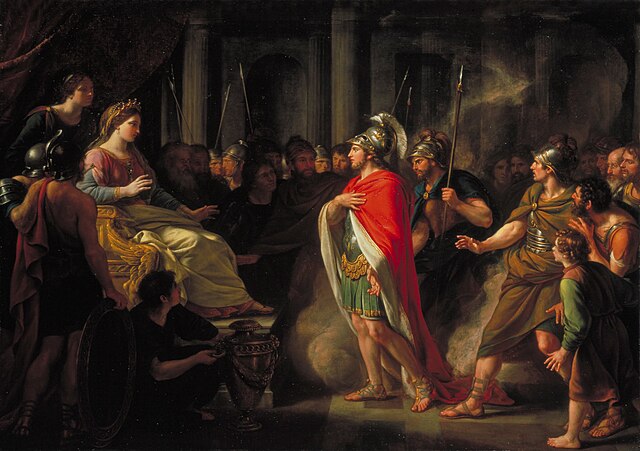
In Virgil’s story, Aeneas is a Trojan prince fleeing the ruins of Troy, carrying his father on his shoulders and his household gods in his hands, charged by fate with founding the civilisation that will become Rome. Storms drive his fleet to the shores of Carthage, in present day Tunisia where Dido, a widowed queen who has built a great city receives him with extraordinary generosity. The goddess Venus (Aphrodite in the Greek lexicon), Aeneas’s mother, ensures that Dido falls in love with him. They become lovers and Dido believes herself to be married. Then Jupiter, the supreme Roman god sends Mercury, his messenger to remind Aeneas of his destiny, to found Rome. As he prepares to sail, Dido confronts him, pleads, rages and finally, as his fleet leaves the harbour, mounts a funeral pyre and kills herself with his sword.
It is one of the most devastating episodes in all of classical literature. Virgil gives Dido such force of feeling, such dignity in her suffering, that readers across two millennia have struggled to accept that Aeneas was right to leave, even though Virgil’s narrative insists that he was.
Henry Purcell’s opera Dido and Aeneas, composed around 1688 and the first great opera in the English language, compresses this story to its emotional essence. The opera is only about an hour long, but its final scene, and in particular Dido’s lament, When I am laid in earth, achieves a depth of feeling that few works in the repertoire can match. Purcell sets the lament over a descending ground bass, a musical figure that repeats and repeats beneath the voice like fate itself, inescapable and indifferent. It is among the most perfectly constructed expressions of grief in all of music.
Seen through the Spiral of Love, Dido and Aeneas is a study in the human cost of two people being shaped entirely by forces outside themselves — one by love, the other by duty — and the devastation that follows when neither can transcend their condition.
Dido – Surviving Love
Dido begins from a position of genuine authority. She has survived the murder of her husband, fled her homeland, and built Carthage through intelligence and determination. There is sovereignty in her history.
But when she loves Aeneas, something shifts beneath that authority. Her love does not coexist with her selfhood. It reorganises everything around his presence. When he prepares to leave, she does not grieve the loss of a relationship. She experiences the dissolution of the self that relationship had come to sustain.
This is the signature of Stage 1 Surviving Love, where connection is sought and maintained not as a free choice between two autonomous people, but as the primary structure holding the self together. When that structure is removed, there is nothing left to stand on.
Her lament does not rage against Aeneas. It asks only to be remembered. Everything in her life and her love has become organised around him.
Aeneas – Pleasing Love Bound by Duty
Aeneas is one of the most frustrating figures in classical literature precisely because he is neither villain nor coward. He loves Dido, or believes he does. But his love has never been fully his own. It was arranged by Venus, permitted by Jupiter, and withdrawn by Mercury. He is a man whose emotional life is entirely organised around the approval and instruction of external authority.
In the language of the Spiral of Love, Aeneas operates from Stage 2 Pleasing Love — not pleasing Dido, but pleasing the gods, fate, destiny, Rome. His identity is structured around compliance with a larger order. When Mercury calls, he does not choose to leave. He simply cannot conceive of remaining.
He is not cruel. He is, in a profound sense, not yet fully present as a subject at all. He has no real control over his own desires. He moves through the myth as someone whose inner life has never been genuinely his own.
The Tragedy of Dido and Aeneas
What makes this story so enduringly painful is that it offers no villain and no remedy. Dido loves from a stage of emotional development that makes Aeneas’s departure unsurvivable. Aeneas operates from a stage that makes his continued presence impossible.
Purcell’s music understands this. The descending bass beneath Dido’s lament does not express anger or protest but expresses inevitability.
Dido does not die because Aeneas was faithless. She dies because she could not survive the loss of the one thing her love had been built upon.
And he sails on, carrying his destiny, looking back only once.
Read more about the theoretical framework behind the Spiral of Love™