There is a figure who haunts Western literature’s imagination of love with unusual persistence. He is the man who desires everything and commits to nothing, who moves through women like a conqueror through provinces, and who meets his end not at the hands of any lover but at the hands of the supernatural. Don Juan (French and Spanish), or Don Giovanni (Italian) in Mozart’s 1787 opera is not, on the surface, a story about love at all. And yet the myth endures because it is, at its deepest level, about what happens when desire becomes detached from the developmental work that love requires.
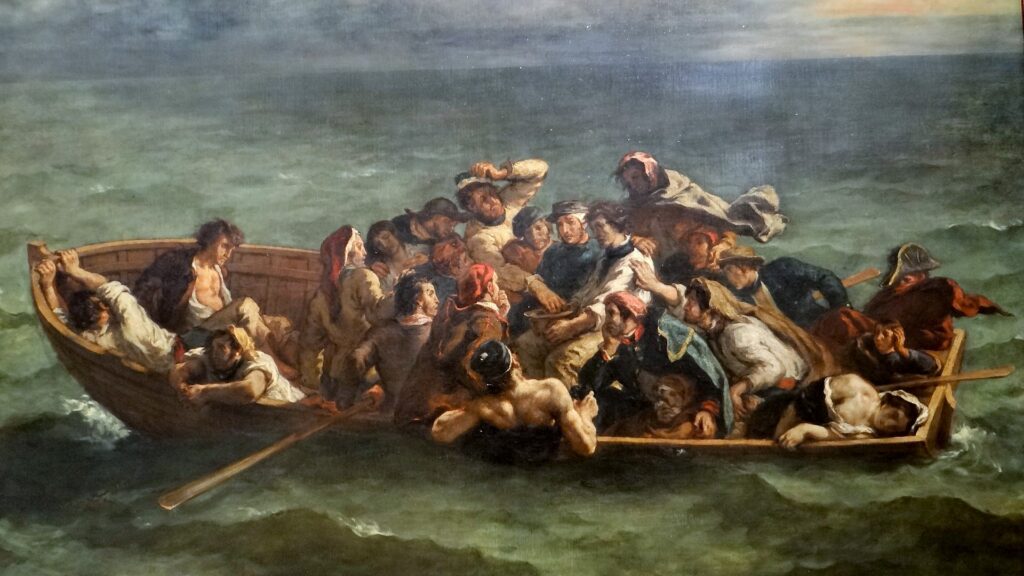
The character first appears fully formed in a Spanish play, El Burlador de Sevilla by Tirso de Molina’s in 1630, already equipped with his essential features: the seducer, the murdered father, the stone guest and the descent into hell. The French playright Molière’s Dom Juan of 1665 makes him a philosophical libertine — colder, more intellectual and almost sympathetic in his refusal of hypocrisy. Byron’s epic poem Don Juan inverts the myth entirely, making Juan the pursued rather than the pursuer, a passive beauty buffeted by the desires of others, the joke now turned on those who project onto him.
What the Spiral of Love reveals is that these successive retellings are not simply variations on a theme. They are, collectively, a cultural argument about which stage Don Juan actually occupies and whether what looks like freedom might be something else entirely.
Don Giovanni – Performing Love
Mozart’s Don Giovanni, with libretto by Lorenzo da Ponte was first performed in Prague in 1787, and it remains the definitive treatment of the myth. The opera opens with assault and murder within the first ten minutes. Don Giovanni attempts to rape a noblewoman, Donna Anna, kills her father the Commendatore when discovered, and appears untroubled by either act. The famous catalogue aria, in which his servant Leporello itemises Don Giovanni’s 2,063 conquests across Europe, is usually played for dark comedy. Through the Spiral of Love, it reads as a clinical portrait of Stage 3 Performing Love in its most extreme and arrested form.
Stage 3 derives relational value from image, performance and desirability. The self is constituted through the impression it makes. The other is not a person but a surface to perform against. Don Giovanni does not love; he scores notches on his bedpost. Each conquest is not an encounter but a confirmation of his power, his magnetism and his inexhaustible desirability. What is striking, psychologically, is how little pleasure he appears to take in any of it. He is already moving to the next conquest before the previous one has ended. This is not appetite but compulsion. Stage 3, at its most defended, cannot rest in genuine contact because genuine contact would require being seen. Being seen would mean being known, and being known would mean being vulnerable.
Don Giovanni is, in this reading, not a man of extraordinary freedom but of extraordinary limitation. His libertinism is not sovereignty; it is the most elaborate possible avoidance of intimacy. The distinction matters. He cannot stop not because he loves too much but because he has never loved at all, and somewhere beneath the performance, he knows it.
Donna Elvira – Projecting Love
Elvira is the opera’s most psychologically compelling figure, and the Spiral of Love illuminates her precisely. She has been seduced and abandoned by Giovanni, has followed him across the continent, and arrives on stage in a state of furious, unresolvable ambivalence. She cannot forgive him and she cannot let him go. Her arias oscillate between rage and longing with a rapidity that, in lesser analyses, reads as instability. In Spiral terms, it is the defining signature of Stage 4, Projecting Love
She is not in love with the real Don Giovanni. She is in love with the Don Giovanni she constructed, the man who, she believed, truly saw her and truly chose her. That man however never existed. She projected a capacity for genuine love onto a man congenitally incapable of it, and when reality collapsed the idealisation, she was left not with loss but with a wound that can never heal. Her tragedy is that she cannot mourn what was real, because what she mourns never was.
Her final plea to Don Giovanni is the most heartbreaking moment in the opera. She begs him to repent, not to save his soul in any straightforward sense, but because his repentance would at least confirm that the man she loved was real. He refuses, almost gently. His refusal destroys her last remaining projection. She leaves the stage, is literally knocked aside by devils in the finale, and disappears. Da Ponte and Mozart seem uncertain what to do with her at the end, which is itself revealing: Stage 4 has nowhere to go once the illusion is finally shattered.
Donna Anna – Awakening Love
Donna Anna is the opera’s most debated figure — whether Don Giovanni actually assaulted her, whether she is in some sense complicit, whether her grief for her father conceals something more ambiguous. The Spiral of Love does not resolve that ambiguity, but it does clarify her functional position in the drama. She is the character in whom genuine self-reflection is most visible.
Her grief for the Commendatore is real, her pursuit of justice is real, and her repeated deferral of her engagement to Don Ottavio suggests someone genuinely unsettled by what she has experienced, and trying to integrate something she does not yet fully understand. This is the movement of Stage 5 Awakening Love: love becoming a site of learning rather than simply a site of feeling. She does not dissolve, like Elvira; she does not comply, like Zerlina, the simple peasant girl seduced in Act I; she reflects, grieves, and holds herself together through it all. She is not yet at resolution, but she is, uniquely among the opera’s characters, moving.
Don Ottavio – Pleasing Love
Ottavio, Anna’s devoted fiancé is often dismissed as a cipher, the ineffectual tenor, the cuckold who does nothing while everyone around him suffers. Through the Spiral of Love, he can be seen as something more sympathetic, as a man whose love is genuine but organised entirely around service, compliance and the suppression of his own needs in favour of Anna’s. He defers to her at every turn, swears to avenge her father, and yet never quite acts. He is not a coward; he epitomises Stage 2 Pleasing Love, constitutionally unable to assert himself because his relational identity is entirely constructed around the needs of the beloved.
His arias are among the most beautiful Mozart ever wrote, which is dramatically significant. The music gives him an inner life his behaviour cannot express. He feels deeply; he simply cannot translate feeling into autonomous action. In a different opera, with a different partner, he might find his way forward. In this one, he is left, at the end, waiting.
The Myth’s Argument with Itself
What is striking across the different versions of the myth is that they all try to find Don Juan’s redeemable core and keep failing. Molière makes him honest about his hypocrisy, which is the closest he comes to self-awareness in any version. Byron makes him passive, shifting the projection onto the women around him and effectively arguing that Don Juan is not a stage of development but a screen onto which others project.
The Spiral of Love asked us to question whether Stage 3, taken to its extreme, can be distinguished from a kind of living death. Don Giovanni at the opera’s end is dragged to hell by the Commendatore’s statue. He refuses to repent, and this refusal is always played as defiance, even grandeur. But the Spiral of Love invites a different reading: he cannot repent because repentance requires access to the self, and the self is precisely what his performance has spent a lifetime concealing from himself. The flames that consume him are, in this sense, not a punishment from without. They are the inevitable consequence of a life lived entirely at the surface.
The tragedy of Don Giovanni is not that he is punished for his desire. It is that he never desired anything real enough to be worth the punishment.
Read more about the theoretical framework behind the Spiral of Love™
Leave a Reply