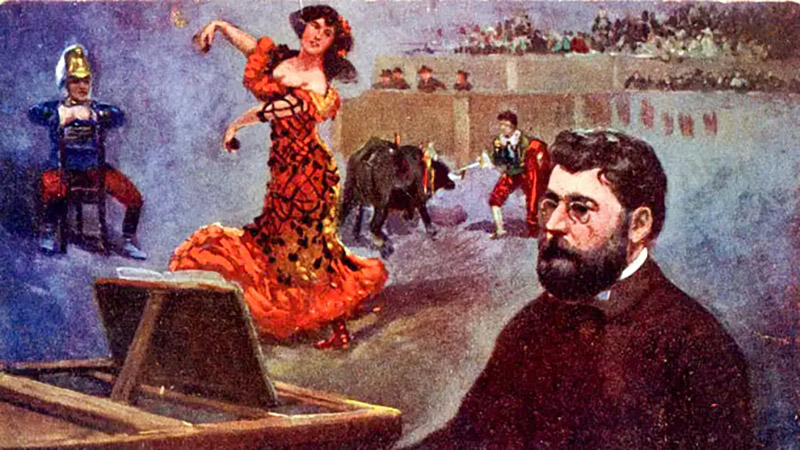
Love in the arts is rarely straightforward. It almost always involves complications and reversals that may or may not be resolved. Of all art forms, opera dwells most intensely on love, often in its most extreme, passionate and tormented forms.
In opera we rarely see balanced attachment, conscious communication, or negotiated boundaries. Instead we encounter longing, jealousy, devotion, duty and defiance. Opera shows us love at the point where it destabilises identity.
Carmen by Georges Bizet, is one of the most popular operas ever written. It offers a powerful lens through which to explore how different forms of love collide.
Seen through the Spiral of Love, Carmen becomes less a story of seduction and more a study of mismatch, about what happens when people love from radically different psychological positions.
Carmen – Sovereign Love
Carmen does not love for survival, approval, or security. She loves because she chooses to.
In the words of the Habanera, her first aria sung outside the tobacco factory:
“Love is a rebellious bird that nobody can tame…
it’s a gypsy child that has never known a law.”
This is not simply flirtation. It is a statement of relational philosophy.
Carmen embodies Stage 7 Sovereign Love.
She retains self-authorship.
She refuses possession.
She is not interested in permanence.
She embraces risk without surrendering autonomy.
She enters relationships freely and leaves them freely, entirely on her own terms.
Importantly, she does not collapse when attachment shifts. She does not beg or control. When her feelings change, she states it plainly.
Her love is immediate, embodied and experiential – full of tension and contradiction:
“If you don’t love me, then I love you.
But if I love you, be on your guard.”
Don José – Projecting Love
Don José, the Spanish soldier ordered to arrest Carmen after a knife fight, begins from a very different place.
His life is structured around duty, obedience and approval.
He is devoted to his mother.
He follows orders.
His identity is organised around belonging and pleasing others.
When he meets Carmen, something breaks. What he experiences feels like destiny.
Psychologically, however, it resembles Stage 4 Projecting Love.
José places Carmen on a pedestal.
He abandons his duties.
He reshapes his identity around her presence.
He mistakes intensity for depth.
Carmen becomes less a partner than a psychological anchor.
He orbits around her, but he never truly inhabits her world.
Escamillo – Conscious Love
As in many operas, the relationship evolves into a love triangle.
Carmen becomes bored with José and turns toward the matador Escamillo.
Escamillo is attracted to Carmen, but he is not destabilised by her. He courts her publicly and confidently. He does not demand exclusivity as proof of love, and he does not collapse when she resists.
Within the Spiral of Love framework, Escamillo represents a more regulated stage, closer to Stage 6 Conscious Love.
There is still performance. After all, he is a matador, a public figure living through his image. But he does not project existential meaning onto Carmen in the way José does.
With Escamillo, Carmen meets someone capable of standing beside her autonomy rather than attempting to conquer it.
The Love Triangle in Carmen
Seen through the Spiral of Love, the opera’s central triangle becomes:
Carmen – Sovereign Love
Don José – Projecting Love collapsing into Surviving Love
Escamillo – Conscious Love
The Tragedy of Carmen
The tragedy of Carmen is not that Carmen is too free.
It is that Don José experiences her freedom as a threat.
When Carmen withdraws, José cannot adapt to the loss. His projection collapses into panic. What once felt transcendent becomes a survival crisis.
By the final act he is no longer pleading or idealising.
He is fighting annihilation.
Opera often glorifies emotional intensity. Bizet’s music makes projection feel sublime.
But viewed through the Spiral of Love, Carmen asks a quieter and more unsettling question:
What happens when one person loves from sovereignty, and another loves from fear?
Carmen remains true to herself.
José fragments.
Escamillo survives.
The opera does not punish freedom. It exposes the instability of attachment that cannot differentiate.
We are moved by the intensity of love, but the music also reveals something deeper: intensity without integration becomes destructive.
Don José’s tragedy is not that he loved too much.
It is that he could not tolerate Carmen’s sovereignty.
And as so often in opera, the story ends in violence, tragedy and death.
Read more about the theoretical framework behind the Spiral of Love™
Leave a Reply