Of all the myths that have passed from antiquity into the operatic canon, none has proved more irresistible than the story of Orpheus. It has attracted composers across the centuries — Monteverdi, Gluck, Offenbach, and many others — precisely because it poses, in the starkest possible terms, the central question that all great love stories circle around: how much of yourself are you willing to lose for another person?
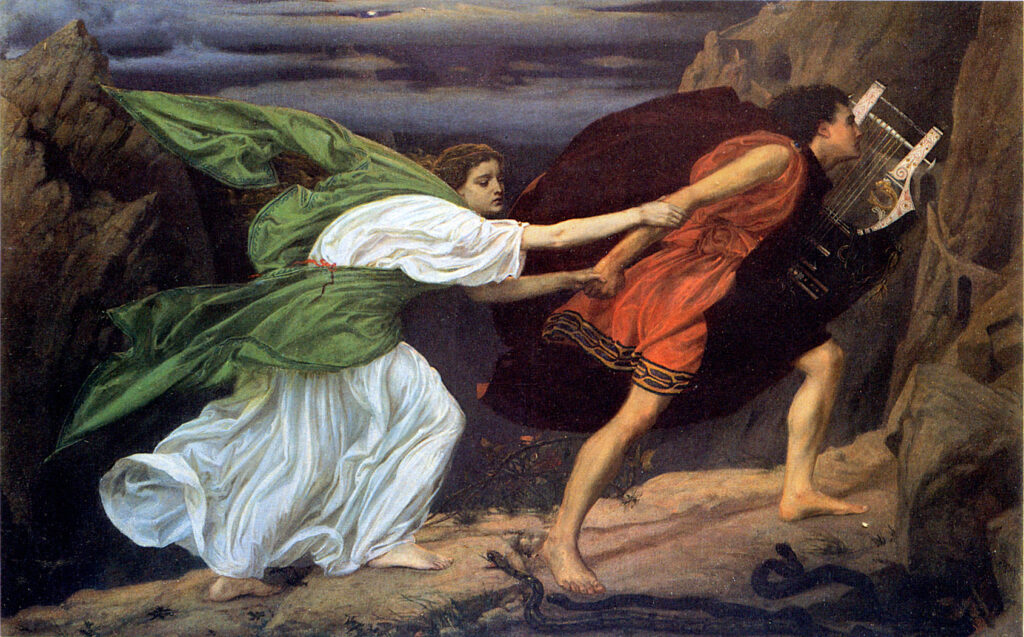
The myth is ancient, pre-literary, rooted in the Orphic tradition of Greece, but its most familiar classical version appears in Ovid’s Metamorphoses. Orpheus is the supreme musician, son of Calliope, one of the great muses whose playing moves not only human beings but animals, trees and stones. He marries Eurydice, who dies almost immediately, bitten by a serpent as she flees the unwanted advances of the god Aristaeus. Orpheus descends into the underworld to reclaim her, his music charming Cerberus, the fearsome dog guarding the entry to the underworld and finally Hades, the god of the underworld himself. Orpheus is granted his wish on a single condition: that he walks ahead of Eurydice on the ascent and does not look back. Of course he looks back and she is lost forever. He returns to the world alone, rejects all other love, and is eventually torn apart by the Maenads, the ecstatic followers of Dionysus, for his devotion to grief.
The myth has generated radically different operatic treatments. Monteverdi’s L’Orfeo, first performed in Mantua in 1607, is the earliest opera in the repertoire regularly staged today, and holds to the darker logic of the original. Gluck’s later version, Orfeo ed Euridice softens the story, giving Eurydice a full emotional life and providing a redemptive ending in which love is restored. Offenbach’s comic masterpiece Orphée aux enfers inverts it entirely. His Orpheus is relieved when Eurydice dies, and he descends to the underworld only because public opinion insists upon it, his looking back engineered by Jupiter who wants her to stay in hell. The opera is intended as a satire on bourgeois marriage and departs fairly widely from the original myt.
But Monteverdi takes the myth seriously, and sets it most honestly. Seen through the Spiral of Love, L’Orfeo is a study in the nature of Projecting Love, and in what is revealed when that projection is put to its ultimate test.
Orpheus – Projecting Love
Orpheus’s love for Eurydice is absolute and consuming. But it is worth asking what, precisely, he loves.
In Monteverdi’s opera, Orfeo’s great aria Possente spirto, in which he pleads with the gods of the underworld is a demonstration of grief so elaborate, so virtuosic, so conscious of its own power, that it could be seen as a performance. He is not simply a man destroyed by loss. He is a man discovering, within some part of himself, what loss enables him to become.
But his music reaches its greatest heights not in Eurydice’s presence but in her absence. This is the signature of Projecting Love. The beloved is not encountered as she actually is, but as the figure onto whom everything urgent and unlived has been cast. The real Eurydice, walking behind him in the dark, breathing, living and present is less sustaining than the image he carries of her.
And so he looks back. Not from weakness. Not from doubt. But because genuine encounter with a living, present other is precisely what Projecting Love cannot finally sustain.
Eurydice – Pleasing Love
Eurydice’s near-silence in the myth is its most revealing feature. She appears only to die, to be retrieved, and to be lost again. She has no visible desires, no independent agency, no life the myth considers worth narrating.
This is not simply a failure of ancient storytelling. It reflects a psychological truth about Pleasing Love: those who inhabit this stage organise their identity so completely around the needs and presence of another that their own interior life becomes invisible to others and eventually to themselves.
Gluck’s version makes this legible in a way Monteverdi’s does not. His Eurydice speaks, questions, pleads. Her entire emotional reality is organised around what Orpheus feels and wants. When he will not look at her, she reads his silence as withdrawal of love, and the anguish this produces is the anguish of someone whose self-worth depends entirely on being seen and approved by the other. It is Pleasing Love made audible.
But in neither versions does Eurydice resist, protest, or act independently. She follows, waits, and disappears.
The Tragedy of Orpheus
The tragedy is not that Orpheus looked back. It is that looking back was inevitable.
Projecting Love cannot sustain genuine encounter with a living, present, complicated other. It can sustain longing, grief, and the exquisite pain of absence. The condition placed on Orpheus — walk forward without looking, trusting what you cannot see or control — is precisely the condition Projecting Love finds unendurable.
At the close of Monteverdi’s opera, Apollo offers Orpheus consolation: he will see Eurydice’s beauty reflected in the stars, in nature, in everything. On one reading this is transcendence. On another, it is the confirmation of everything the myth has revealed. Orpheus is not given back Eurydice. He is given back his projection of her — purified, permanent, and safely beyond the complications of actual encounter.
His music will go on forever, and she will remain exactly as he needs her to be.
Read more about the theoretical framework behind the Spiral of Love™
Leave a Reply